
2. Aerobic and Resistance Activity: The Benefits and How to Get Started
 Aerobic Activities:
Aerobic exercise, otherwise known as heart-health, endurance or cardiovascular exercise, is an activity that stimulates and improves the functioning of your heart and lungs. Aerobic activities are essential for overall cardiovascular health and endurance.
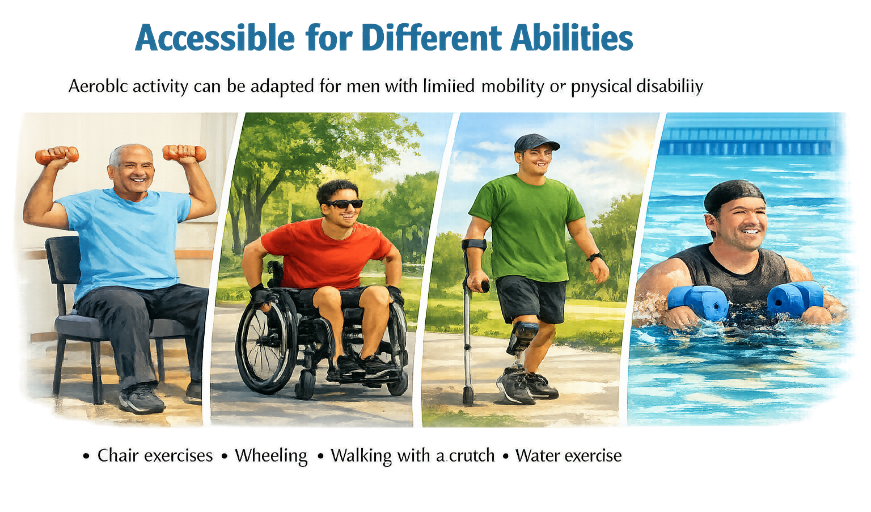
 There are many examples of aerobic exercise, for example, walking, running, cycling, swimming and gardening. However, it can also include fun, social and culturally appropriate (and often free) activities like undertaking traditional dance through to forming a community soccer or cricket club. For men with disability or limited mobility, aerobic exercise can be adapted and may include chair-based exercise, wheeling, supported walking, water-based activity, or other forms of movement that raise the heart rate and improve endurance.
Benefits of Aerobic Activity:
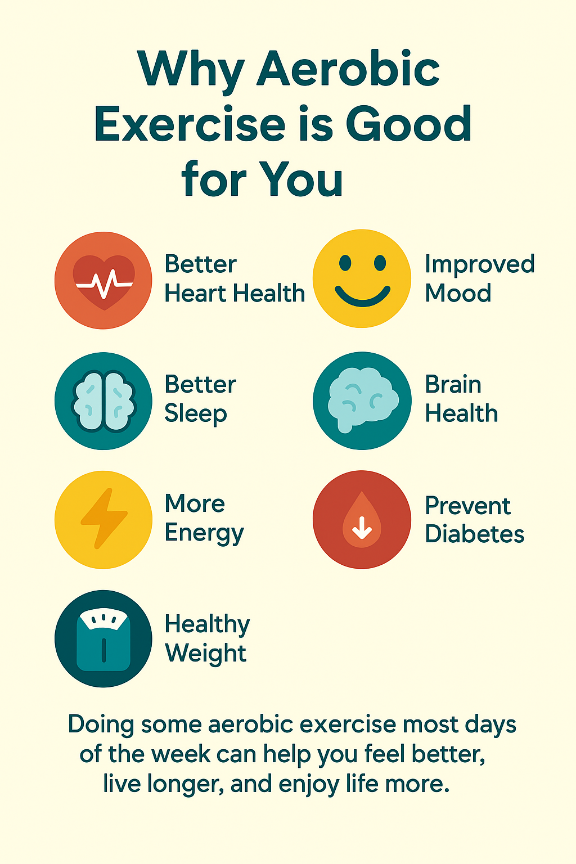
Aerobic exercise helps your body and mind in many ways. Some of the key benefits are:
- Heart Health: Helps your heart and blood vessels stay strong.
- Improved Mood: Makes you feel happier and less stressed.
- Better Sleep: Helps you sleep more easily and deeply.
- More Energy: Boosts stamina and reduces fatigue.
- Brain Health: Keeps your mind sharp and memory strong.
- Healthy Weight: Helps manage your weight.
- Reduces Diabetes risk
Aerobic activity for men with different abilities:
Aerobic activity can be adapted for men with limited mobility or physical disability. Chair-based cardio, wheeling, supported walking, water-based exercise, or repeated upper-body movement can still improve fitness and health.
General Tips for Aerobic Exercise:
 Choose Enjoyable Activities: Select activities that you enjoy, such as walking, cycling, swimming, dancing, chair-based exercise, wheeling, supported walking, or water-based activity, to increase the likelihood of sticking with your routine.
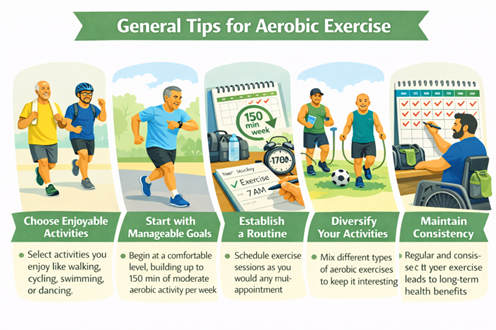 Start with Manageable Goals: Start at a level you feel comfortable with. Gradually, you can build up what you do, aiming for at least 150 minutes of moderate aerobic activity per week, or 75 minutes of vigorous activity, depending on your abilities and health status. Additionally, incorporate muscle-strengthening exercises on two or more days per week.
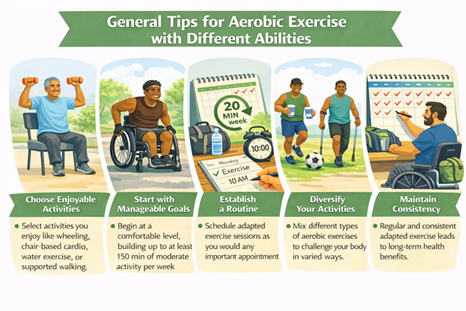 Establish a Routine: Schedule exercise sessions as you would any important appointment to ensure consistency.
Diversify Your Activities: Mix different types of aerobic exercise to keep your routine interesting and to challenge your body in varied ways. Adapt activities where needed so they are safe, practical, and suited to your level of mobility and function.
Maintain Consistency: Consistent exercise is key to achieving and sustaining long-term health benefits. Even short sessions and adapted forms of movement can improve fitness, health, and well-being.
Make it social: Include your friends, spouse, and children – It’s a great chance to model healthy behaviours and spend time together with your loved ones and friends**.**
Regular Aerobic Activity – Fast Facts
• 20%–30% lower risk of early death in adults who are sufficiently active.
• 20%–30% lower risk of heart disease and stroke with high leisure-time physical activity.
• 26% lower risk of type 2 diabetes with high leisure-time physical activity; 35% lower risk with high total physical activity.• 11.5% depression cases prevented if inactive adults reach recommended activity levels.
Resistance (strength) activities:
Resistance exercises focus on strengthening muscles through activities that require the body to work against external resistance – for instance, lifting weights. These exercises are vital for muscle development and overall physical strength. Strength-building exercises don’t have to happen in a gym – you can do them from your own living room for free.
Benefits of Resistance Activity:
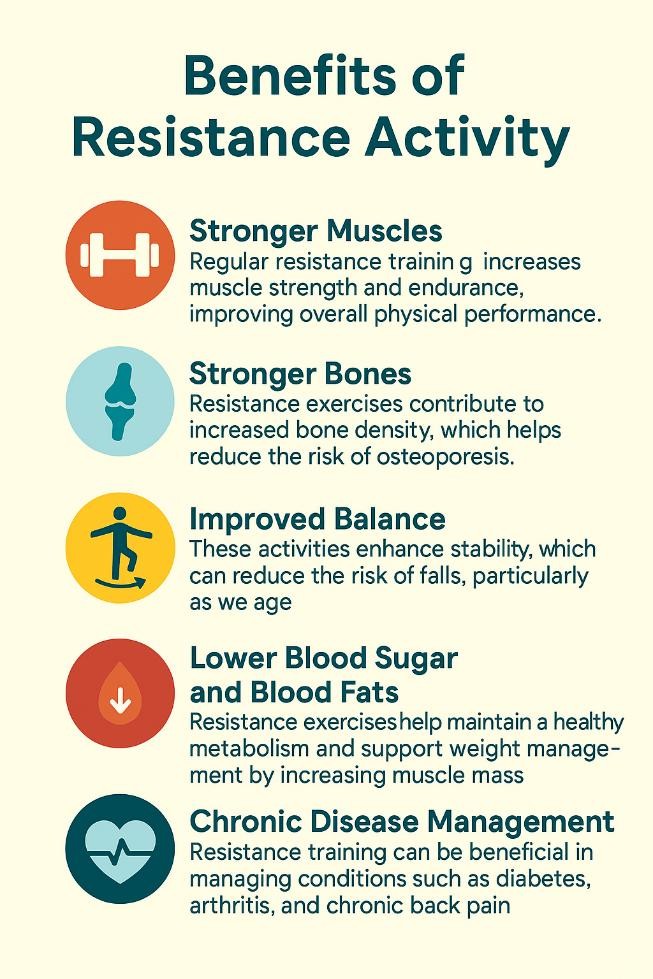 Stronger muscles: Regular resistance training increases muscle strength and endurance, improving overall physical performance.
- Stronger Bones: Resistance exercises contribute to increased bone density, which helps reduce the risk of osteoporosis.
- Improved Balance: These activities enhance stability, which can reduce the risk of falls, particularly as we age.
- Lower blood sugar and blood fats: Resistance exercises help maintain a healthy metabolism and support weight management by increasing muscle mass.
- Chronic Disease Management: Resistance training can be beneficial in managing conditions such as diabetes, arthritis, and chronic back pain.
Strategies to Incorporate Resistance Activities into Your Routine
Here is a simple resistance-training routine with 4 upper-body movements and 4 lower-body movements.
Upper Body
- Sit in a high-back chair
- Make sure your bottom is right at the back of the chair, and your back is straight
- Hold a 1 kg weight in each hand. If 1kg is too heavy, use a can of sweetcorn or similar, ~450 grams
- Do 20 repetitions of each of the movements pictured below. Then rest briefly, and then do another 20 of each movement. If you cannot manage 20, do as many as you can and gradually build up to 20.
- Do the movements slowly, breathing in and out with each.
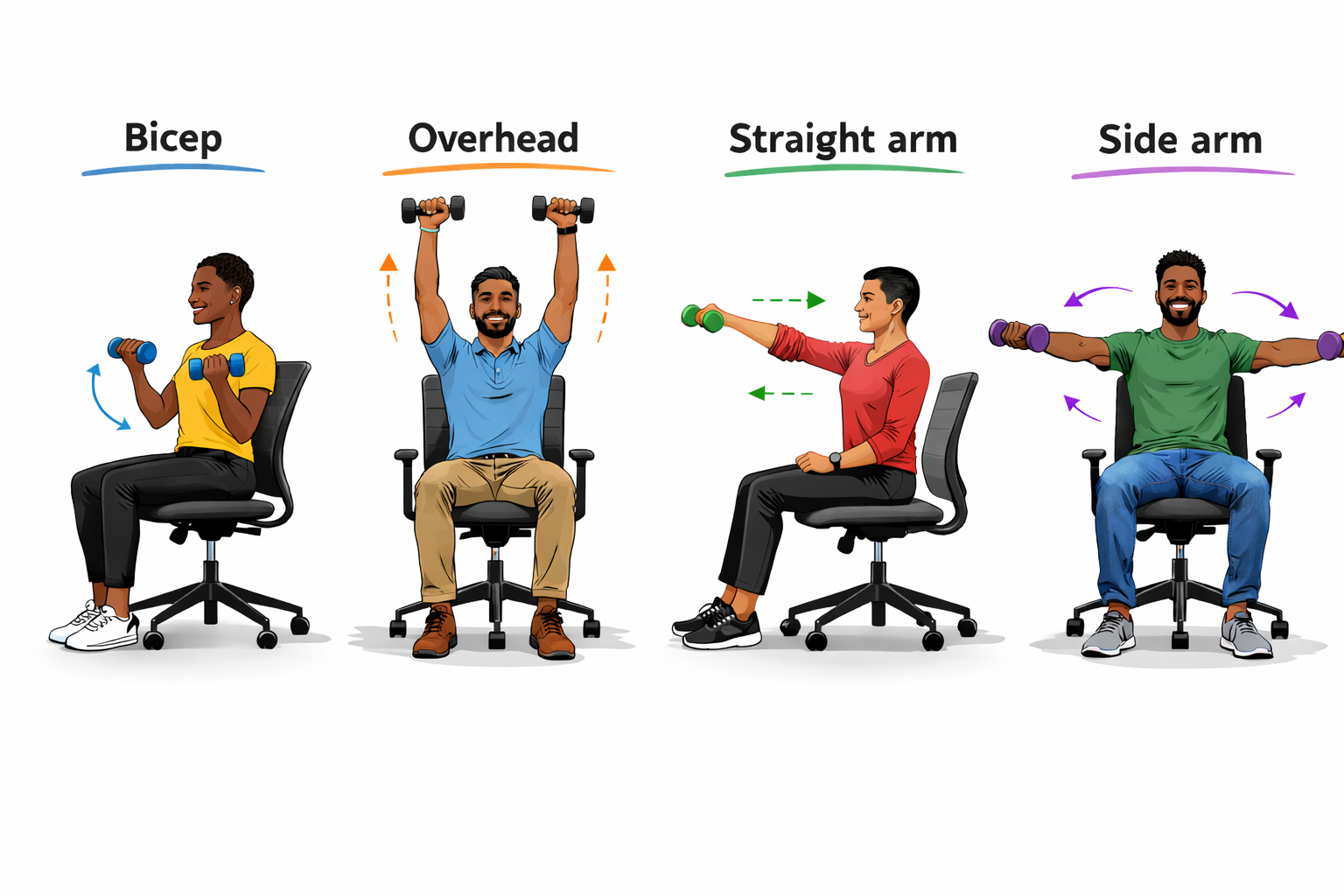 Do these at least 3 days of the we
When you have completed the 2 lots of 20 repetitions of each of the 4 movements (or as many as you can do), stand and go for a walk for 10 minutes. Even if it is just around the house.
Now you are set to do the lower body
Lower Body
- For these, you need 1kg ankle weights. Or use strips of lead covered with material, with Velcro straps to fasten them around your ankles. You can also fill a small pouch with 1kg or 500 grams of course sand, attach some ties or Velcro straps so that one can be strapped around each ankle
- In the pictures below, you will see that one of these exercises is done sitting in the chair, as you do for the upper body exercises. Two are done standing behind the chair and holding on. The final one is done lying on the bed. Maybe leave this one for last.
- Do 20 repetitions of each of the movements pictured below. Then rest briefly, and then do another 20 of each movement. If you cannot manage 20, do as many as you can and gradually build up to 20.
- Do the movements slowly, breathing in and out with each.
- Do these at least 3 days of the week
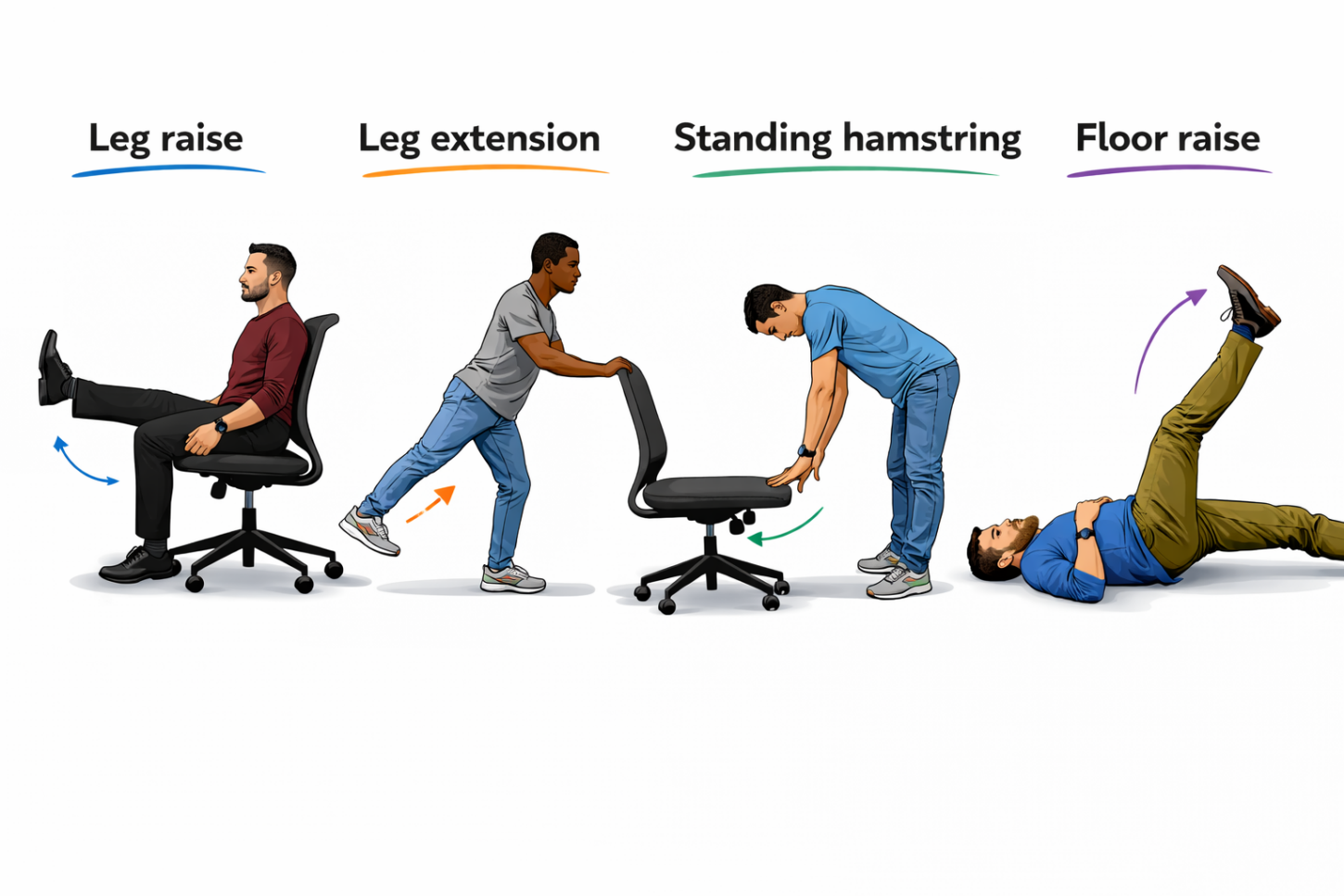
When you have completed the 2 lots of 20 repetitions of each of the 4 movements (or as many as you can do) stand and go for a walk for 10 minutes. Even if it is just around the house.
For men with disability or different abilities.
If you have limited mobility, disability, pain, or balance problems, resistance exercise can still be helpful and can be adapted to suit you.
You may need to do the exercises sitting down, use lighter weights or resistance bands, do fewer repetitions, or have support nearby for standing exercises.
Start with what you can manage safely, build up gradually, and focus on good form.
Talk to your GP who can refer you to a physiotherapist or exercise physiologist to help you choose appropriate exercises.
Regular Resistance Activity – Fast Facts
- 15% lower risk of death from any cause with any resistance training versus none.
- 19% lower risk of cardiovascular death with resistance training.
- 14% lower risk of cancer death with resistance training.
- 10%–17% lower risk of all-cause mortality, cardiovascular disease, cancer, and diabetes.
- HbA1c decreased by about 0.39 points and done density increased by 0.6%
Incorporating both endurance and strength activities into your routine is essential for maintaining overall health and fitness. Whether you are aiming to improve cardiovascular health, increase strength, or manage a chronic condition, regular exercise is crucial.
Start with small, manageable goals, remain consistent, and make physical activity a regular and enjoyable part of your life. Every step taken toward increased movement contributes to better health and well-being.
SERVICES INFORMATION
Community Centres and Programs
• City of Adelaide Community Centres (incl. Adelaide Southwest Community Centre)
Low-cost and free activities such as yoga, Pilates, and social groups.
Website: https://www.cityofadelaide.com.au/community/community-centres/
Phone: (08) 8203 7203
• City of Salisbury
Cycling, Strength for Life, Walking groups.
Website:www.salisbury.sa.gov.au/cyclesalisbury
• Playford Wellbeing Hub (Smithfield Plains)
Programs for physical health, mental wellbeing, and community connection.
Website: https://www.playford.sa.gov.au/explore/whats-on/playford-wellbeing-hub
Phone: (08) 8256 0333
• Neighbourhood Houses SA
Local centres offering community programs, social groups, and basic support services.
Website: https://neighbourhoodhouses.org.au/
Phone: (08) 8394 9170
• Sport and Recreation SA
Supports participation in sport and community activity programs.
Website: https://www.sportsa.org.au/
Phone: (08) 8354 3111
Outdoor Facilities and Activities
• Adelaide Park Lands
Free open spaces with walking trails, cycling paths, and sports courts.
Website: https://www.cityofadelaide.com.au/parklands/
Phone: (08) 8203 7203
• Rymill Park
Public park with playgrounds, walking areas, and BBQ facilities.
Website: https://www.cityofadelaide.com.au/directory/rymll-park-murlawirrapurka/
Phone: (08) 8203 7203
• parkrun (multiple SA locations)
Free weekly 5km walking or running events.
Website: https://www.parkrun.com.au/
Aquatic and Fitness Centres
• Adelaide Aquatic Centre
Public pools and fitness facilities (redevelopment underway).
Website: https://www.cityofadelaide.com.au/recreation/sport-fitness/adelaide-aquatic-centre/
Phone: (08) 8203 7203
• YMCA SA Recreation Centres
Affordable gyms, group classes, and community programs.
Website: https://ymca.org.au/sa/
Phone: (08) 8200 2516
• Local Council Recreation Centres
Access to gyms, pools, and fitness classes at low cost.
Website: https://www.lga.sa.gov.au/sa-councils/council-finder
Phone: varies by council
• Australian Refugee Association
Walking and Health Literacy. Term-based physical activity program for multicultural communities
Nutrition and Wellbeing Term-based nutrition and wellbeing program for multicultural communities
Website: https://www.australianrefugee.org/
Programs for Older Adults
• COTA SA – Strength for Life Program
Supervised strength training for people aged 50+.
Website: https://cotasa.org.au/programs/strength-for-life/
Phone: (08) 8232 0422
• Active Ageing Australia
Programs and resources for older adults to stay active.
Website: https://www.activeageingaustralia.org.au/
Phone: (03) 9888 2190
Walking and Physical Activity Programs
• Heart Foundation Walking Groups
Free, community-led walking groups across SA.
Website: https://walking.heartfoundation.org.au/
Phone: 13 11 12
• Be Active SA (Preventive Health SA)
Campaigns and programs that promote physical activity.
Website: https://www.preventivehealth.sa.gov.au/
Phone: (08) 8226 6313
Sports Clubs and Participation
• Local Sports Clubs (via council directories)
Community sport including football, cricket, basketball, and more.
Website: https://www.lga.sa.gov.au/sa-councils/council-finder
• Sporting Schools / local initiatives
Entry-level programs to support participation in sport.
Website: https://www.sportaus.gov.au/schools
Phone: (02) 6214 1111
Aboriginal-Specific Health and Wellbeing Services
Primary Health Care (ACCHOs)
• Nunkuwarrin Yunti of SA (Adelaide)
GP, dental, mental health, and community wellbeing services.
Website: https://nunku.org.au/
Phone: (08) 8406 1600
• Moorundi Aboriginal Health Service (Murray Bridge)
Primary care and social and emotional wellbeing programs.
Website: https://www.moorundi.org.au/
Phone: (08) 8531 0289
• Pika Wiya Health Service (Port Augusta)
GP care, chronic disease management, and outreach.
Website: https://pikawiya.com.au/
Phone: (08) 8642 9999
• Port Lincoln Aboriginal Health Service (PLAHS)
Clinical care and health promotion.
Website: https://plahs.org.au/
Phone: (08) 8683 0162
• Nunyara Aboriginal Health Service (Whyalla)
Preventative health and community programs.
Website: https://www.nunyara.org.au/
Phone: (08) 8645 4555
• Yadu Health Aboriginal Corporation (Ceduna)
Primary care, aged care, and mental health services.
Website: https://www.yadu.org.au/
Phone: (08) 8626 2500
• Nganampa Health Council (APY Lands)
Clinics, dental, and mental health services in remote communities.
Website: https://www.nganampahealth.com.au/
Phone: (08) 8954 9000
• Pangula Mannamurna (South East SA)
Primary care and wellbeing services.
Website: https://pangula.org.au/
Phone: (08) 8724 7270
Social and Emotional Wellbeing / AOD
• Aboriginal Drug and Alcohol Council SA (ADAC)
Alcohol and other drug programs and workforce support.
Website: https://adac.org.au/
Phone: (08) 8362 0395
• Aboriginal Sobriety Group
Residential rehabilitation and recovery services.
Website: https://asg.org.au/
Phone: (08) 8445 0100
• Kornar Winmil Yunti (KWY)
Programs for Aboriginal men, families, and healing.
Website: https://kwy.org.au/
Phone: (08) 8377 7822
Mental Health and Crisis Support
• 13YARN
24/7 crisis and emotional wellbeing support line.
Website: https://www.13yarn.org.au/
Phone: 13 92 76
• Lifeline (13 11 14)
24/7 crisis support (also available to Aboriginal people).
Website: https://www.lifeline.org.au/
Phone: 13 11 14
Community and Cultural Support
• Aboriginal Health Council of SA (AHCSA)
Supports Aboriginal health services and workforce statewide.
Website: https://ahcsa.org.au/
Phone: (08) 8274 1099
• Aboriginal Family Support Services (AFSS)
Family support, child protection, and community programs.
Website: https://afss.com.au/
Phone: (08) 8212 1112
Notes for Use
• Many Aboriginal services provide holistic care, including physical health, mental health, family support, and community programs.
• Community centres and local programs can support early engagement, prevention, and social connection alongside clinical services.